1031 Exchange Guide

1031 EXCHANGE

1031 Exchange Guide

A 1031 exchange can allow real estate investors to sell qualifying investment or business property and reinvest into other qualifying real estate while potentially deferring recognition of gain.

The federal 1031 exchange rules apply throughout the country, and investors may also face state-level reporting and withholding considerations, particularly when exchanging property for replacement real estate located in another state.

This guide explains the key federal rules and the state-level issues property owners should understand before beginning an exchange.

1031 EXCHANGE

How Does a 1031 Exchange Work?

Section 1031 is a federal provision, and states generally follow the federal framework for qualifying real property exchanges. Under current federal law, like-kind exchange treatment is limited to real property.

At the federal level, Section 1031 generally allows gain to be deferred when qualifying real property held for investment or business purposes is exchanged for other qualifying real property.

The transaction still needs to satisfy the applicable federal exchange requirements. State conformity does not eliminate the need to properly structure and complete the exchange.

1031 EXCHANGE

What Types of Property May Qualify?

Section 1031 generally applies to real property held for productive use in a trade or business or for investment.

Depending on the circumstances, qualifying real estate may include:

01

Rental properties

02

Apartment buildings

03

Commercial properties

04

Industrial real estate

05

Office properties

06

Retail properties

07

Land held for investment

08

Other qualifying business or investment real estate

Property held primarily for sale generally does not qualify, and a personal residence used solely as a home typically does not fall within Section 1031. Investors with mixed-use, vacation, or previously owner-occupied property should discuss their circumstances with a qualified tax professional.

1031 EXCHANGE TIMELINE

1031 Exchange Timeline

Investors generally follow the same federal timing requirements that apply to deferred 1031 exchanges throughout the United States.

45 DAYS

45-Day Identification Period

Potential replacement property generally must be identified within 45 days after the transfer of the relinquished property.

180 DAYS

180-Day Exchange Period

The replacement property generally must be received within 180 days after the transfer of the relinquished property, subject to the applicable federal income tax return deadline.

1031 EXCHANGE

Can You Exchange Property for Property in Another State?

01

Yes, qualifying investment real estate can potentially be exchanged for qualifying real property located elsewhere in the United States.

02

Federal like-kind rules generally do not require the relinquished and replacement properties to be in the same state. U.S. real property, however, is not considered like-kind to real property located outside the United States.

03

This flexibility can be valuable for property owners who want to evaluate opportunities in different markets.

04

However, moving the replacement property into another state can create additional state reporting considerations.

STATE TAX REPORTING

State Reporting and Out-of-State Replacement Property

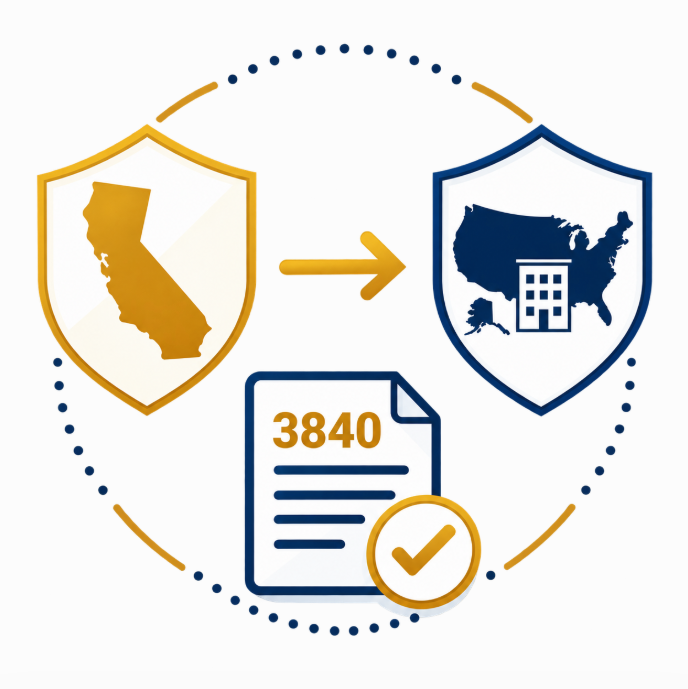
Some states continue to track certain deferred gains when real estate located in that state is exchanged for property outside the state.

  1. RELINQUISHED PROPERTY
  2. 1031 EXCHANGE
  3. OUT-OF-STATE REPLACEMENT PROPERTY
  4. STATE-SOURCE GAIN REMAINS DEFERRED
  5. STATE INFORMATION RETURN

WHEN STATE REPORTING GENERALLY APPLIES

If an investor exchanges property located in one state for one or more properties located in another state and any portion of the source-state realized gain or loss remains unrecognized, the investor may be required to file a state like-kind exchange information return.

The form generally must be filed:

  1. For the taxable year in which the exchange occurs
  2. For each subsequent taxable year while the state-source gain or loss remains deferred

WHY THIS MATTERS FOR INVESTORS

This is one of the most important considerations for investors evaluating replacement property in another state.

STATE TAX CONSIDERATIONS

Does Moving Replacement Property Out of State Eliminate State Tax?

Investors should not assume that exchanging property for real estate in another state eliminates the original state's interest in the deferred gain.

Several states maintain reporting systems designed to track state-source gain that remains deferred after an exchange into out-of-state property.

The eventual tax treatment depends on the investor's circumstances and what happens with the replacement property.

Because residency, property location, subsequent exchanges, and eventual disposition can affect the analysis, investors considering an out-of-state exchange should involve a qualified state tax professional early in the process.

STATE TAX CONSIDERATIONS

State Real Estate Withholding and 1031 Exchanges

Many states have real estate withholding requirements that can apply when real property is sold or transferred.

A properly structured simultaneous or deferred Section 1031 exchange can qualify for an exemption from withholding on the qualifying exchange amount. State withholding certificates typically include a certification for transfers intended to qualify as Section 1031 exchanges.

However, withholding issues may arise if:

  • The investor receives taxable cash or other non-like-kind property

  • The exchange fails

  • The transaction does not ultimately qualify for Section 1031 treatment

Where a deferred exchange is certified on the applicable state withholding form, a Qualified Intermediary may have withholding obligations if taxable boot is received or if the exchange fails or does not qualify.

REPLACEMENT PROPERTY OPTIONS

Your Replacement Property Does Not Have to Be in Your Current Market

Selling investment real estate can provide an opportunity to reconsider where and how you want to own property.

Your next investment might involve another property in your current market, real estate in another state, multiple replacement investments, or certain professionally managed real estate structures.

That flexibility can be especially relevant for property owners who want to:

  • Diversify beyond a single market

  • Explore different property types

  • Reduce active property management

  • Reposition into markets with different investment characteristics

  • Consider professionally managed real estate

  • Adjust their strategy as financial or retirement priorities change

The right replacement property strategy should reflect your objectives rather than assuming your next investment must resemble the property you sold.

Explore 1031 Replacement Property Solutions
Can a DST Be Used for a 1031 Exchange?

1031 EXCHANGE

Can a DST Be Used for a 1031 Exchange?

For some accredited investors, a Delaware Statutory Trust may be another replacement property strategy to evaluate.

Under the circumstances described in IRS Revenue Ruling 2004-86, beneficial interests in a properly structured DST may be treated as interests in the underlying real property for federal tax purposes, allowing certain DST interests to potentially qualify as replacement property in a Section 1031 exchange.

DSTs can provide access to professionally managed real estate but also involve important considerations including liquidity, fees, financing, sponsor risk, property performance, and limited investor control.


EXCHANGE PLANNING

Why Early Planning Matters for Property Owners

Waiting until an investment property closes can significantly reduce the time available to make a thoughtful replacement property decision.

Planning earlier gives you an opportunity to:

  • 01

    Understand your exchange timeline

  • 02

    Establish replacement property criteria

  • 03

    Engage a Qualified Intermediary before closing

  • 04

    Discuss state tax considerations with your CPA

  • 05

    Consider whether replacement property may be located in another state

  • 06

    Evaluate direct and professionally managed real estate options

  • 07

    Prepare for state reporting requirements where applicable

1031 EXCHANGE

Work With the Right 1031 Exchange Professionals

A 1031 exchange may involve several professionals with distinct responsibilities.

Your Qualified Intermediary facilitates specific aspects of the exchange. Your CPA or tax advisor can address federal and state tax treatment. Your attorney can advise on legal matters, while your real estate broker can assist with the property transaction.

Customized 1031 focuses on helping investors understand and evaluate the replacement property and investment side of the decision.

1031 EXCHANGE

Planning a 1031 Exchange?

Investors have access to a broad range of potential replacement property strategies, but state reporting requirements and exchange deadlines make planning important.

If you are preparing to sell investment property and want to understand the replacement property options available to you, talk with Doug Zator about what you want your real estate equity to accomplish next.

This information is provided for general educational purposes only and is not intended as tax, legal, or investment advice. Federal and state tax laws and reporting requirements can change, and their application depends on individual circumstances. Investors should consult their own Qualified Intermediary, tax advisor, attorney, and other appropriate professionals before entering into a 1031 exchange.